
When does AI document processing become tangible? A gas safety certificate example
10 September 2026A practical guide to turning documents into trusted records and actions.
AI document processing becomes tangible when it removes measurable manual effort, reduces risk or helps work move forward faster.
If someone can describe a process as, “I open the document, work out what it is, find the correct record, capture the important information and decide what happens next,” it is likely to be a strong candidate for AI document processing.

A simple test for a tangible use case
The strongest opportunities usually have five characteristics:
- Document volumes are significant enough for manual handling to create cost, delay or backlog.
- The document types, required information and desired outcomes can be defined.
- People repeatedly classify, capture, match and file the same kinds of records.
- Errors or delays create measurable operational, service or compliance risk.
- Someone owns the exceptions that should not be processed automatically.
The same pattern can support incoming documents, digital mailrooms, data cleansing and migrations. Gas safety records are one practical example—not the limit of the proposition.
Gas safety records: one worked example
A gas safety record—often still searched for as a gas safety certificate or CP12—is a useful example because it must be matched to the right property, checked for required information, retained as evidence and acted on if a defect is recorded. It is one example of the wider document-processing method, not a specialist limit on what Indexer can process.
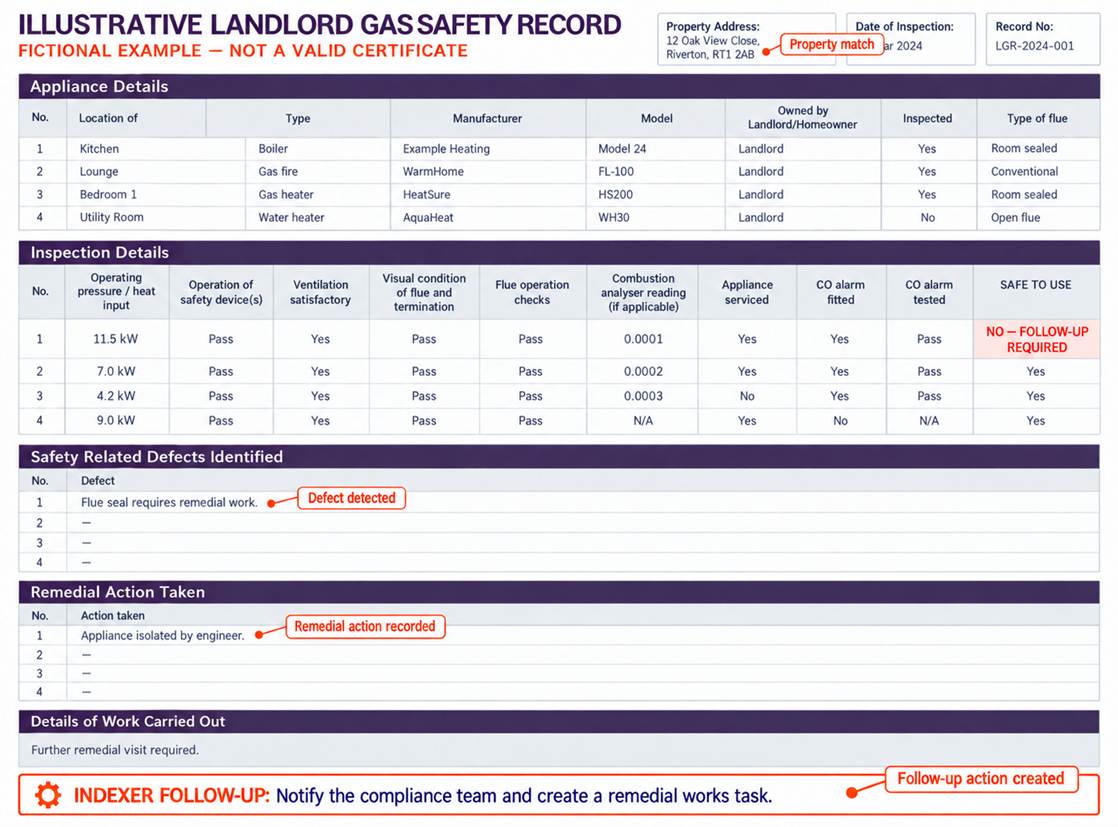
Illustrative sample: fields and layouts vary between providers, so the model and processing rules should be configured, trained where required and tested against representative documents.
In this example, Indexer matches the certificate to the correct property, identifies the defect, recognises the immediate action already taken and creates a follow-up task for the outstanding remedial visit. Depending on the organisation’s rules, the certificate could be filed automatically while the remediation workflow is escalated for human oversight.
Indexer reads what has already happened, identifies what still needs to happen and initiates the appropriate business workflow. It does not perform the remedial work or replace the professional judgement of the responsible teams.
How to use AI to process gas safety certificates
1 Define the document and the outcome
Start by agreeing what counts as the correct certificate, which information must be captured, where the final record belongs and what should happen when a defect, missing field or inconsistency is identified. The desired business outcome should be clear before automation is configured.
2 Capture certificates from each route
A contractor may email a certificate, upload it through a portal or provide a scanned copy. A certificate may also be generated by a field-service platform. Indexer can monitor the agreed source and begin processing when a document arrives, without requiring someone to download and re-upload it manually.
3 Classify the document and check its source
AI identifies whether the file is the expected certificate type rather than unrelated correspondence or supporting evidence. For system-generated documents, validation can check expected source details, identifiers, layout and data consistency. These checks can identify anomalies, but authoritative verification requires comparison with a trusted source or system.
4 Extract the information that matters
The model reads the certificate and extracts the fields required by the organisation. For a gas safety record, the statutory minimum includes the property address; the appliances or flues checked and their locations; the check date; the engineer’s name, registration number and signature; the landlord or agent; safety defects and remedial action; and confirmation that the required safety matters were examined.
Source: HSE guidance on gas safety check records
5 Match the correct property record
The property address, reference and other identifiers can be compared with trusted business data. A strong match may allow the certificate to continue automatically. If several properties could match, an identifier is missing or the data conflicts, Indexer can route the document for review rather than risk misfiling it.
6 Apply confidence thresholds and business rules
The decision should consider the complete result, not one headline AI score. A document could be classified correctly with 98% confidence while an essential field—such as the property reference or safety outcome—remains uncertain. Automation should therefore consider confidence at document, field and record-match level, alongside business rules. Review may still be required when mandatory information is absent, approval is needed or the document arrives from an unexpected source.
Apply the appropriate controlled outcomes
Once the certificate has been read and checked, Indexer can apply one or more controlled outcomes:
- Auto-file with confidence. The certificate, required fields and property match meet the agreed thresholds and validation rules, so it is filed with the correct metadata and records controls.
- Bring a human into the loop. Indexer presents the original certificate, extracted information and reason for review so the person can resolve the exception without repeating the full process.
- Act on the document content. A defect, observation, result or date can create a task, notify the responsible team, update a status or initiate an agreed workflow.
Keep people in control of exceptions
Human review provides a controlled route for uncertainty, approval and higher-risk decisions. Review decisions also create reviewed examples that can be used to refine models, rules and thresholds, with changes tested before they enter the live process.
The aim is to automate predictable work while making exceptions quicker and safer to resolve.
Add controls that make the result trustworthy
Confidence is only one signal. Before straight-through filing, compare critical values with trusted data, check mandatory fields and retain traceability to the source. Route contradictions, unreadable scans, unexpected formats, duplicates and safety findings for review. Preserve the original file and the decision audit trail.
Electronically stored gas safety records should remain secure against loss or interference, reproducible in hard copy and linked to the engineer and any follow-up action.
Measure whether the use case is delivering value
Measure processing time, the proportion filed without intervention, exception volumes, incorrect property matches, time to identify defects and the unprocessed backlog. Start with representative certificates and clear rules for human involvement, then increase automation only when the evidence supports it.
Where Filer Indexer fits
If documents are accumulating in inboxes, SharePoint sites, scanned-mail queues or migration repositories, the starting point is not choosing an AI model. It is mapping the document, the decision and the outcome. That is where Filer Indexer begins.
If you have a document-heavy process involving repeated classification, data capture, filing or follow-up decisions, that is a practical place to start. We can help map the document, the decision points and the controlled outcomes before deciding how much should be automated.
Which document-heavy process would you automate first?
You might also be interested in…
-
 15 November 2022
Using SharePoint for Legal Records Management
Firstly, what is Records Management? Let’s break it down quickly. Records – This is a document that can serve as…By Dave Clark -
 3 September 2024
Why Your Organization Needs a SharePoint-Based EDRM
The stakes are too high: regulatory compliance, data security, operational efficiency, and even your competitive edge depend on how well…By Eva Luna-Rose -
 9 October 2025
How Can I Stop our Dynamics 365 CE Users From Reworking SharePoint URLs to Find Documents They Shouldn’t?
The Challenge: Granular Permissions vs. Flat Document Libraries Organizations using Dynamics 365 Customer Engagement (CE) often implement granular security models…By Dan Kong